Market ·
Who ChatGPT Recommends to Small Business Buyers: What 133 Questions Showed
We asked ChatGPT 133 buyer questions. When our name was not in the question, it named HubSpot and Apollo often, linked home pages, and never named us.
By Digvijay Yadav, Founder, Baljia AI · LinkedIn
Baljia is an AI employee for founders and small businesses. It gets you found and books meetings. Try it on one real goal: a 7-day free trial, no credit card.
Start freeIf your buyers ask ChatGPT which tool to use, what do they hear? We asked it 133 buyer questions and recorded every company it named and every link it gave. Here is what a small company can learn from the answers, our own poor result included.
The short answer
On 102 buyer questions that did not mention us, ChatGPT named well-known software most often: itself in 33 answers, HubSpot in 28, Apollo in 17 and Zapier in 16. Two thirds of the links we recorded went to a home page, nearly always the site of a tool it had just named. List articles, directories and forum threads were a small share of the links we could record.
Our own result. We make Baljia. ChatGPT named Baljia in 18 of the 133 answers, and all 18 of those questions had Baljia's name in them. On the 115 questions that did not name Baljia, it named us 0 times and never linked to baljia.ai. When asked about us by name, 6 of the 18 answers repeated prices our site no longer shows.
| What we counted | Result |
|---|---|
| Questions with a complete answer | 133 |
| Questions that named Baljia | 18, all answered with Baljia named |
| Questions that did not name Baljia | 115, Baljia named in 0 |
| Headline sample, keyword notes removed | 102 questions |
| Answers that named a company or product | 101 of 102 |
| Answers with a link we could record | 86 of 102 |
| Links recorded, once per answer | 584, on 260 sites |
| Links that went to a home page | 385 of 584 (66%) |
| Links also in our "list your sources" follow-up | 470 of 584 |
| Most-named software | ChatGPT, HubSpot, Apollo |
| Most-linked site | hubspot.com, in 19 answers |
What did we ask ChatGPT, and how?
We wrote 133 questions in the words a buyer of AI, marketing and sales tools might use. They covered AI employees and agents, building an app with AI, getting found on Google and in AI answers, sales outreach, social media, ads, and alternatives to named AI tools. Eighteen of them named Baljia, so we could also see what ChatGPT says about us.
Each question went into its own temporary chat on the ChatGPT website. We used a free account with no earlier chats in its history, with web search switched on. The browser connection was in India, and the site did not show a model name. We recorded one answer per question over November 6 and 7, 2026.
After each answer, we asked one follow-up in the same chat: list every company or product you named, in order, then every website you used as a source, with its full URL. We kept the links shown in the answer and the links given in that follow-up, and checked the names against the original answer text.
We had planned to put the same questions to Gemini as well. That part was not completed, so everything here is about ChatGPT only.
Which questions count. The headline numbers use 102 questions: the 115 that did not name Baljia, minus 13 that went in with a planning note attached. The section on keyword notes below explains why we took those 13 out.
Did ChatGPT name Baljia?
ChatGPT named Baljia only when the question already did. All 18 questions with Baljia in them got an answer naming Baljia. 17 of those answers cited baljia.ai, and we recorded a baljia.ai link for 16 of them. The odd one out was a question about running Google ads, where ChatGPT mostly described a different company with a similar name and asked whether we meant Baljia.
On the other 115 questions, ChatGPT named Baljia 0 times, and baljia.ai never appeared among the links. Those include questions we would like to be named on, such as which AI employee a small business should use, and which tool finds leads and books meetings for B2B founders.
That is the honest starting point. On these questions, asked on these two days, a buyer who did not already know our name would not have heard it from ChatGPT.
Which tools did ChatGPT name most often?
The tools ChatGPT named most often were itself, HubSpot, Apollo and Zapier, out of a long tail of 412 different names as recorded across the 102 answers. Most names were rare: 258 appeared in only one answer, and only 16 appeared in 10 or more. The median answer named 9.
A small group of well-known software came up again and again. For the table below, we counted each answer once per company and grouped product names under their maker, so Zapier Agents counts as Zapier and HubSpot Breeze counts as HubSpot. Google products are listed separately, because they do different jobs, and mentions of OpenAI are not added to ChatGPT.
| Software | Answers naming it, of 102 |
|---|---|
| ChatGPT | 33 |
| HubSpot | 28 |
| Apollo | 17 |
| Zapier | 16 |
| Canva | 15 |
| Google Ads | 15 |
| Lindy | 15 |
| Lovable | 15 |
| Replit | 12 |
| Google Business Profile | 11 |
| n8n | 10 |
ChatGPT named itself more often than any other software.
Channels came up often too. Counted by exact name, LinkedIn was named in 40 answers, more than any software. Instagram followed in 29, Google in 25 (apart from named Google products such as Google Ads), WhatsApp in 21 and Facebook in 14. Many of our questions asked where to find customers.
Seventeen of the 102 questions were about another product by name, for example Lovable or Polsia alternatives, and that lifts those products. On the other 85, the leaders were ChatGPT in 32 answers, HubSpot in 27, Apollo in 17 and Canva in 15. Lovable fell to 7 and Replit to 4.
Which websites did ChatGPT link to most often?
ChatGPT linked to hubspot.com most often, in 19 of the 102 answers, followed by apollo.io and zapier.com in 14 each.
We could record at least one link for 86 of the 102 answers. In at least 11 of the other 16, the answer showed named source labels, but ChatGPT did not give their links when we asked. Counting each link once per answer, we recorded 584 links on 260 different sites.
470 of the 584 links also appeared in the source list ChatGPT gave when we asked for it. Many were linked in the answer too, such as a "Website" link under each tool it named. We saved most answers as plain text, which did not keep where each link sat, so we do not split the two. Our notes also show that in several answers the source list gave product home pages instead of the pages the answer had cited.
These are the sites linked in the most answers. Subdomains count with their main site, so blog.hubspot.com counts as hubspot.com, and Google's developer docs count as google.com.
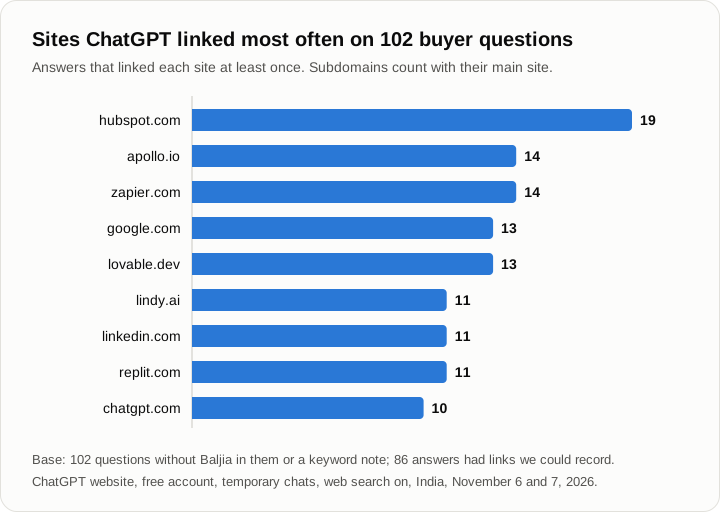
Every site on that list belongs to a company whose product ChatGPT was talking about. In 115 of the 116 cases where an answer linked one of these nine sites, the same answer also named that company.
The google.com links were different in kind. They were 28 links in 13 answers, mostly Google's help pages, developer docs and tools such as Search Console.
The pattern held on the 85 questions that were not about another product by name: hubspot.com was linked in 18 answers, apollo.io in 14, google.com in 12 and linkedin.com in 11.
What kinds of pages were those links?
Two thirds of the links were home pages: 385 of 584. We sorted all 584 links by their address, without opening the pages. A home page is a bare domain. A list, comparison or review article is one whose address says something like best, top, alternatives, vs, compare or review.
| Kind of page | Links | Share | Answers with one |
|---|---|---|---|
| Home page | 385 | 66% | 71 |
| Product, feature or pricing page | 72 | 12% | 40 |
| Article, guide or news page | 55 | 9% | 25 |
| Help, docs, policy or government page | 32 | 5% | 17 |
| List, comparison or review article | 29 | 5% | 13 |
| Directory or marketplace listing | 6 | 1% | 5 |
| Forum, social post or social search | 5 | 1% | 3 |
Shares are rounded, so they add to 99%.
The home-page links were mostly product links. 372 of the 385 went to the site of a company or product named in that same answer. In plain terms, ChatGPT usually pointed at the tools it named, not at the articles behind the choice.
Those articles are partly hidden from us. In 54 of the 102 answers, our notes record citations whose full links we could not recover. In 12 of them, some of the missing citations were labeled as comparison or review articles. So the list and review count above is an undercount.
The list articles we could see bunched up in a few answers. Of the 29, 15 came from just two answers: 9 from a question about Polsia alternatives and 6 from a question about the best AI tools for founders.
Forums barely appeared. Among the links we could record, no Reddit or Quora thread showed up in any of the 102 answers. The reddit.com links were only a home page or a search page, in 3 answers about finding first users and buyers.
What changed when a question carried a keyword note?
A keyword note changed the answers. Thirteen of our questions went in with a planning note we meant to keep for ourselves, written like (keyword: 210 a month). We kept the questions exactly as written for the record.
In 8 of those 13, ChatGPT read the number as a budget or a price, for example planning a $210 a month tool stack. In the other 5, it read the number as search volume, and in 3 of those the answer turned into a plan for writing an article on that keyword. Baljia was named in none of the 13.
So we left all 13 out of the headline numbers. The lesson carries over to your own check: type the question exactly as a buyer would, with nothing added. A stray number can change what you are told.
Can ChatGPT repeat old facts about your business?
Yes. Answer engines can repeat stale facts, so check what they say about you. In 6 of the 18 answers about Baljia, ChatGPT quoted at least one price from an older version of our pricing, and 3 of those also gave an old trial length. Some of those answers named our own site as the place the old figures came from. In two more, the source list it gave pointed to baljia.com, which is not our domain.
When we scanned the 87 pages in our sitemap, llms files and feed on November 7, 2026, none showed the old figures. As of that scan, our pricing page listed Starter at $49.99 a month at its launch price, Growth at $99.99 and Scale at $249.99, with LinkedIn outreach on Growth and Scale only.
ChatGPT got plenty right as well: 6 of the 18 answers gave our current US prices, some of them next to old figures, and 6 gave the current 7-day trial.
We do not know which copy of our pages ChatGPT read. What we can do is keep the facts on our own pages current, ask search engines to crawl them again, and ask the same questions again in a few weeks.
What should a small company take from this?
Five lessons from this run carry over to any small company.
- Ask before you spend. Our result, 0 of 115, was invisible to us until we asked. Twenty minutes of questions tells you where you start.
- Expect big names at the top. A few well-known vendors led both the names and the links, while most other names appeared once. Being named once is not the same as being named often.
- Make your home page say what you do. If this run is any guide, a link from ChatGPT to you is most likely to land on your home page. Put what you do, who it is for and what it costs there, in plain text.
- Ask about yourself by name. That is where we found the old prices, and a buyer who already knows your name may ask that way.
- Do not read one run as a ranking. One answer per question is a snapshot, not a score.
What are the limits of this data?
This data has seven limits, and each one narrows what it can tell you.
- One engine. The ChatGPT website only. This says nothing about Gemini, Perplexity, Google's AI answers or any other engine.
- One country. The connection was in India, and some answers used Indian budgets and vendors. A buyer in the US may see different answers.
- One account. A free account, in temporary chats, with no model name shown. We did not compare paid plans.
- Two days, one answer each. Answers vary from run to run. A second run could name a different mix, so treat every count here as a sample.
- Not search volume. We do not know how often buyers ask these questions, so no count here says how many people saw an answer.
- Our questions. We make Baljia, and we chose and worded the questions. Different wording can bring different answers.
- Incomplete links. We saved most answers as plain text, so we cannot say which links a buyer saw in the answer and which only came back when we asked for sources. In 54 of the 102 answers, some cited links could not be recovered, and we sorted pages by address, not by reading them.
How do you run this check on your own business?
You can run this check on your own business with about ten questions, written the way your buyers talk and kept the same each month. You do not need 133. Our 20-minute AI visibility self-check gives you a question set and a way to record answers. Our guide on getting recommended by ChatGPT separates what is documented from what is only observed.
- Write the questions. About ten with no brand names in them, plus three to five that name you.
- Ask each one fresh. Use a new temporary chat with web search on, and type the question with nothing added.
- Ask for the list. After each answer, ask it to list every company it named and every source it used, with full links.
- Record five things. Were you named, were you linked, who else was named, which sites were linked, and anything wrong about you.
- Sort the links. Home pages, product pages, articles, lists and reviews, directories and forums. The mix shows which kinds of pages fed the answer.
- Check your own site. Our free site check tests whether AI crawlers are allowed in and reads your homepage title and description, robots.txt, sitemap and llms.txt; a free SEO and AEO audit goes deeper on one URL.
Then repeat the same questions next month and compare.
Frequently asked questions
Does ChatGPT name many different tools, or the same few?
Both: a few well-known vendors often, and a long tail once. Of 412 names as recorded across 102 answers, 258 appeared in only one answer, while HubSpot and Apollo each appeared in 17 or more. This data does not measure company size.
Why did ChatGPT not name Baljia?
We do not know, and this data cannot say. We observed that baljia.ai was not among the links on any of the 115 questions that did not name us. We have no view inside how ChatGPT picks names, so any single reason would be a guess.
Which websites does ChatGPT link to most?
In this run, software vendors' own sites. hubspot.com was linked in 19 of 102 answers and apollo.io and zapier.com in 14 each. Two thirds of all recorded links went to a home page, usually the site of a tool the answer had just named.
Do list articles and directories matter for ChatGPT answers?
List articles and directories were a small share of the links we could record: 29 list, comparison or review links and 6 directory links out of 584. That is likely an undercount, because in 12 answers some comparison or review sources were shown without links we could recover. The data shows what was linked, not what shaped the answer.
Can I trust what ChatGPT says about my prices?
Not without checking. In 6 of 18 answers about Baljia, ChatGPT repeated old prices that our own site did not show when we scanned it on November 7, 2026.
How often should I check what ChatGPT says about my business?
Once a month with the same questions is a sensible rhythm. Answers vary from run to run, so watch the direction over several months rather than any single result.
Start with your own questions
Run the self-check first, in your buyers' words. If you want the checks run for you, Baljia checks what ChatGPT, Gemini and Perplexity say about you, and has a 7-day free trial with no credit card at https://baljia.ai/.
Sources
- Baljia's ChatGPT visibility records, collected November 6 and 7, 2026: 133 questions, each with one answer and one source follow-up, on the ChatGPT website with a free account, temporary chats and web search on, from India. Includes the saved answers, the follow-ups and a CSV of every run (internal records, no public URL).
- Baljia's scan of its own 87 sitemap, llms and feed pages for old prices (checked November 7, 2026; internal record, no public URL).
- Baljia's current prices: https://baljia.ai/pricing (checked November 7, 2026).
- Every count in this post was recounted from that CSV and the saved answers for this post. Gemini answers were planned but not collected, so none are reported.
See Baljia in 83 seconds
An illustrated walkthrough with music; the examples in it are not a live customer project. See what each scene shows.