Market ·
A Founder Brand on LinkedIn, Without Becoming a Writer
A founder brand is what people can predict about you: one narrow lane, two or three pillars, a 60 to 90 minute weekly batch, and proof in every post.
By Digvijay Yadav, Founder, Baljia AI
The short answer
A founder brand is not reach, a posting streak or a feed of motivational quotes. It is what people can predict about you: the narrow lane you post in, the kind of proof you bring, and the fact that you show up again next week. Two or three topics, a cadence you can hold for twelve weeks, and one piece of real evidence in every post will beat a clever daily sprint that dies in week two.
Pick the lane before you pick the cadence, and force it narrower than feels comfortable. The useful intersection is your own experience crossed with something most people in your market get wrong: "operations" is a feed, while "what breaks when a service business passes ten staff" is a brand. From that lane, choose two or three recurring pillars connected to the problem you solve, not to your product. If a stranger skims your last ten posts, those pillars should be obvious without a bio.
And you do not have to become a writer. Founders who sustain this do not compose from a blank page. They capture raw material while running the business, then turn it into posts in one short weekly batch. The writing is the smallest part of the job.
We make Baljia, which drafts this kind of content, and it appears briefly near the end. The method itself needs a notes app, 60 to 90 minutes a week, and any AI assistant you already use.
Your posts sound automated because of sourcing, not writing
A post drafted from a blank prompt sounds like AI for one reason: it contains nothing only you could know. No tone instruction fixes that. "Make it sound human" produces the same smooth emptiness with warmer adjectives.
The fix is where the material comes from. Draft from things that happened: the question a customer asked twice this month, the objection that killed a deal, a number from your own dashboard, the mistake that cost you a week. Capture one or two of those moments a day in a single running note on your phone, in whatever broken shorthand you think in. Founders rarely fail at this for lack of ideas. They fail for lack of capture, because by Friday the Tuesday moment is gone.
Every business already runs four idea sources whether or not anyone harvests them: what you shipped or changed this week, what customers keep asking, what your own numbers show, and the opinions you find yourself defending in meetings. One line per moment is enough. The note is an inbox, not a draft.
Then hold one rule without exceptions: every post carries one piece of proof. A number, a dated event, a named situation with the names removed, a screenshot. If an idea has no proof attached, it is an opinion that any competitor could also post, and it waits until it earns its evidence. No proof, no post.
The weekly 60 to 90 minute batch
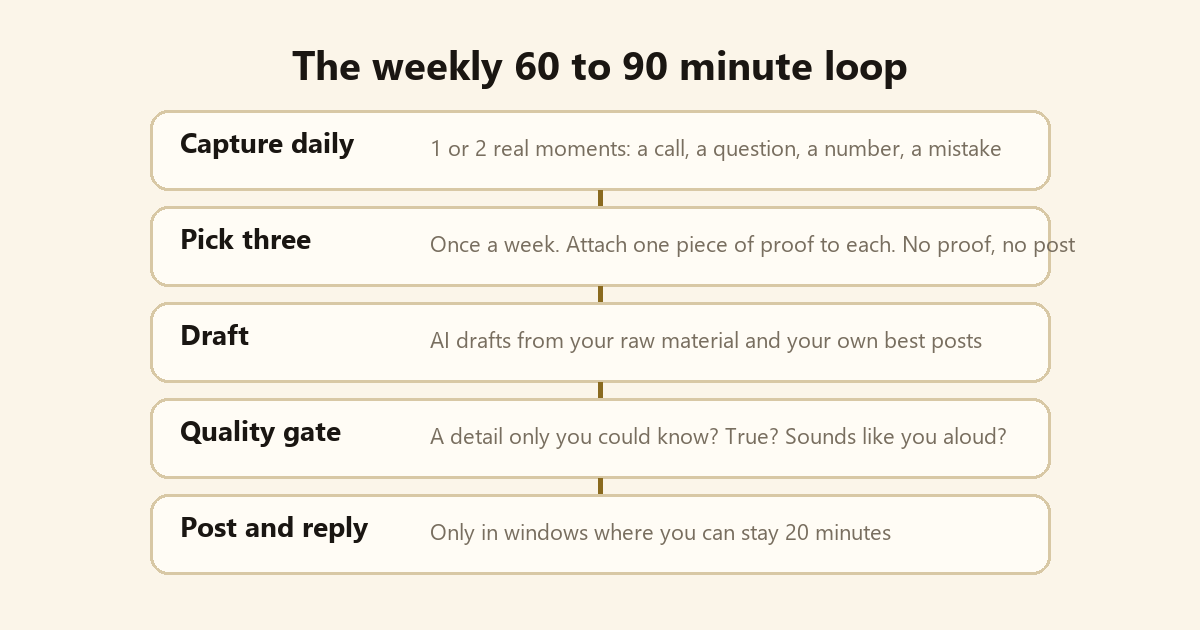
The batch takes 60 to 90 minutes a week; capture happens in the gaps.
Block the hour once a week and run five steps.
1. Pick three moments from the week's note. This choosing is the one part you cannot delegate, because only you know which moment carries a lesson worth a stranger's time.
2. Attach one piece of proof to each. The rule from above, enforced here. A moment that cannot be backed goes back in the note for later.
3. Draft with AI from your material. Give the model the raw note, the proof point, and two or three of your own best past posts to copy the structure of. Structure references work. Adjectives do not: "confident but humble" produces mush, while "shaped like this post of mine" produces something recognizably yours.
4. Run the quality gate. Four questions, and a draft that fails any of them gets fixed or dropped: Is there a detail only I could know? Is every claim true? Does the first line sound like me if I read it aloud? Would I be comfortable if a customer brought this post up on a call?
5. Schedule only into windows you can attend. A post needs you in its comments for the first 20 minutes, answering in ways that invite a second reply. The loudest tell of automated content is not the prose; it is the author who never answers anyone. LinkedIn's own scheduler handles profiles from 10 minutes to three months ahead, so scheduling itself is a normal, supported behavior.
What to post: the 3-2-1 mix
Keep the mix boring and the content specific. For every six posts: three that teach something from your lane, two that start a conversation, one that promotes what you sell. Readers forgive promotion at that ratio because the other five posts paid for it.
Let the format follow the idea instead of fashion. A framework or checklist fits a PDF carousel; a story fits plain text with one image; anything you can show fits a short video. LinkedIn document posts accept a PDF of up to 300 pages, which is to say the format will never be your constraint.
Two lines in every post matter more than the rest. The first line has one job: earn the "see more" click with a number, a specific situation or a claim you are prepared to defend. The last line asks a question a person can actually answer from their own experience. Never "comment YES": LinkedIn's spam help page says it may limit or remove content designed to artificially increase engagement, including chain-letter requests for likes and shares, and your buyers read bait as bait anyway.
Stay inside your two or three topics. Predictability is the asset: strangers decide what you are for by skimming your last ten posts, and a feed that wanders reads as noise.
What LinkedIn rewards in 2026: confirmed versus estimated
Worth separating cleanly, because most "algorithm advice" never does.
Confirmed, from LinkedIn's own pages. Engagement pods are banned and actively reach-limited: the Professional Community Policies tell members not to agree ahead of time to like or reshare each other's content, and LinkedIn's newsroom post of March 13, 2026 says it limits the reach of pods and automated comments and warns of account restrictions. That post defines an automated comment as one posted by a tool rather than a person clicking the button. LinkedIn's spam page adds that emoji and reaction polls that artificially boost engagement, chain-letter posts, and excessive, irrelevant or repetitive comments can be removed or limited. The Professional Community Policies also ban lotteries, contests, sweepstakes and giveaways outright, so leave that whole tactic family alone.
Estimated, from third-party content-analytics vendors. You will read that document carousels are the strongest format, that a lone external link drags a post down, and that comment threads where people answer each other lift reach. LinkedIn has confirmed none of this, and we have not verified the vendors' data. Treat these as hypotheses to test against your own analytics, not laws.
The practical conclusion needs no estimates at all: post for humans in your lane, bring proof, answer your comments, and skip every shortcut that manufactures engagement, because the shortcuts are the one thing LinkedIn has confirmed it punishes.
The honest timeline
Plan for the commonly cited three to six months of consistent posting before inbound interest is noticeable. Twelve weeks, which at two or three posts a week means 24 to 36 posts, is the minimum fair test of a cadence; judging after three posts is judging noise either way.
Wins-only feeds read fake, and your buyers are better at smelling it than you are at hiding it. The bad month with its number attached builds more trust than the launch announcement.
Watch the right signals. Likes and impressions flatter; what predicts business is comments from strangers in your market, profile views after posting, DMs that open real conversations, and connection requests from people who look like buyers. Generic comments usually mean the post was generic.
One warning the personal-branding industry rarely gives: founder-led must not become founder-dependent. If the whole pipeline lives in your profile, it stops the week you get sick or go heads-down. Move the audience somewhere you own as it grows, a newsletter or your own site, and let the company's channels carry part of the weight.
Buy it, do it yourself, or use software
Do it yourself with the batch system above and the all-in cost is 2 to 4 hours a week: capture in the gaps, the 60 to 90 minute batch, plus comment time around each post.
Hire a ghostwriter and you buy back those hours at a price. The market sells in three broad bands: a budget tier of templated posts, a mid tier built on interviews with you, and a premium tier where a team also manages engagement. We have no verified rates to quote, so get current quotes and compare them on how the writer sources material, not on polish. Two costs stay whatever the band: pricing guides commonly cite one to three months for a writer to learn a voice, and the capture problem stays yours, because a ghostwriter without your raw moments writes the same empty posts the blank prompt did. Price any quote against what one qualified lead is worth to you, and count how many leads a month would break even.
The hybrid is where most founders land: software drafts weekly from the material you captured, you approve, post and reply, and anything high-stakes stays handwritten.
Baljia, which we make, is the software option we can speak for. It is an AI employee for founders and small businesses that gets you found and books meetings; on the content side it prepares social posts and blog content that answer buyer questions, for the accounts it supports, and you approve each one from the dashboard or WhatsApp. Publishing with your own click is the default this guide recommends, and switching any work to run by itself is an explicit choice the owner makes, never something that happens quietly. If you later add the selling side, LinkedIn campaigns come with the Growth and Scale plans, outreach stays a draft until you approve it or switch sending on, and the caution from our own site applies: sending limits reduce volume; they do not guarantee account safety or platform permission. The deeper risk question around automated sending is covered in Is it safe to let AI send messages in your name?.
The two halves feed each other. Posts warm the same network your outreach builds, and the people who engage become next week's hand-picked prospect list; that other half of the loop is the subject of How to get customers from LinkedIn. For where content fits in a whole marketing week, see the AI marketing agent page, and if your mornings already drown in AI tabs, the 30-minute founder routine pairs well with the weekly batch. Plans and what each includes are on pricing.
Frequently asked questions
How often should I post on LinkedIn?
Two or three times a week, at a pace you can hold for twelve weeks, beats daily posting that collapses after two weeks of enthusiasm. The cadence you keep is worth more than the cadence you announce. Pick the number you can sustain while running the business, and only raise it after twelve weeks at the current one. A sudden spike in volume also reads oddly to the humans who know you, which is its own argument for steady.
Can I use AI to write my LinkedIn posts?
Yes, when the raw material is yours and you publish with your own click. What LinkedIn's March 2026 newsroom post targets is engagement pods and tool-driven automation: coordinated boosting, and comments posted without a human action. A post drafted by AI from your real experience, checked by you and posted by you is your post. The failure mode is not the AI, it is the blank prompt; posts with no detail only you could know read as automated whoever typed them.
Should I build the brand on my profile or the company page?
Your profile, early on. Buyers answer people, and a Page represents the business (or you, as a sole proprietor) while your profile can carry opinions, mistakes and stories. Keep the Page as the durable home that posts can be shared to, so the audience is not stranded if your own posting pauses.
How long before LinkedIn posting brings leads?
Plan for the commonly cited three to six months of consistent posting in one lane. Earlier than that you should see directional signals, comments from strangers who fit your market and profile views after posting, but pipeline you can count usually takes a quarter or more. Anyone promising faster is selling the sprint that dies in week two.
Does scheduling posts hurt reach?
None of LinkedIn's pages we checked say so, and LinkedIn ships its own scheduler for profiles, from 10 minutes to three months ahead. What does hurt is scheduling into a window you cannot attend, because a post whose author never answers its comments wastes its best hour.
Start with one captured week
Before buying anything, run the free version: capture moments for seven days, batch once, post twice. If you then want the drafting handled for you, Baljia offers a 7-day free trial, no credit card, at https://baljia.ai/. Automations that run on their own start on a paid plan, and LinkedIn campaigns come with Growth and Scale.
Sources
- https://news.linkedin.com/2026/authentic-content-and-conversations (checked November 5, 2026)
- https://www.linkedin.com/legal/professional-community-policies (checked November 5, 2026)
- https://www.linkedin.com/legal/user-agreement (checked November 5, 2026)
- https://www.linkedin.com/legal/l/linkedin-pages-terms (checked November 5, 2026)
- https://www.linkedin.com/help/linkedin/answer/a1338787 (checked November 5, 2026)
- https://www.linkedin.com/help/linkedin/answer/a1347212 (checked November 5, 2026)
- https://www.linkedin.com/help/linkedin/answer/a518909 (checked November 5, 2026)
- https://baljia.ai/llms-full.txt (checked November 5, 2026)